
Our approach
Toward the difficulty, not around it.
Many approaches steer people quickly toward common ground. We slow down at the point of disagreement, because that’s where understanding is found. The method rests on research into how people think, and on the practice it takes to act differently under pressure.
The moment that matters
Most conversations
are decided in two seconds.
Before anyone has chosen their words, the body has already reacted and the mind has already written a story. Good intentions arrive too late. Skill is what lets people catch the moment while it’s happening.
- seconds
- 2.00
- heart rate
- 108
-
Trigger
Someone challenges something you care about: a decision, a value, your competence.
-
Threat
Your body can treat it as danger. Heart rate climbs and attention narrows to defence.
-
Story
You decide what they meant and who they are, usually less charitably than the facts allow.
-
Response
Attack, defend or go quiet. Each one feels justified. Each one closes the conversation.
Monthly team meeting
- Notice the reaction
- Question the story
- Choose the response
Choose the response
-
Reflex
You clearly haven’t read the data.Response Which data are you looking at? I’m reading it differently.
The psychology behind the work
Six findings that
shape every session.
Every exercise we run traces back to research on how people think, decide and react under pressure. These are the findings we return to most.
-
Pluralistic ignorance
Everyone doubts it. Everyone assumes they’re alone.
People privately reject a view while believing most others accept it, so the silence of each person confirms the doubts everyone else is hiding.
In the room
We make private doubts visible early, so people can see how widely they’re shared.
Prentice & Miller, 1993
-
Psychological safety
Teams learn when speaking up is safe.
Teams that share a belief that it’s safe to take interpersonal risks ask more questions, report more errors and learn faster. It’s a property of the group, not of brave individuals.
In the room
Leaders practise the responses that make the next challenge more likely, not less.
Edmondson, 1999
-
Hidden profiles
Groups talk about what they already know.
Discussion gravitates to information everyone shares. The fact only one person holds is the one most likely to go unsaid, even when it should change the decision.
In the room
We use structures that surface unshared information before a decision closes.
Stasser & Titus, 1985
-
Naive realism
We assume we see things as they are.
So people who disagree must be uninformed, irrational or biased. Both sides believe this about each other, which is why goodwill alone rarely bridges a divide.
In the room
Participants state the other side’s view until its owner says, “Yes, that’s it.”
Ross & Ward, 1996
-
Identity-protective cognition
When a belief signals who we are, evidence bends.
If a position is tied to the groups we belong to, we weigh evidence in ways that protect our standing in them. Greater reasoning ability doesn’t reliably protect against it.
In the room
We separate the claim from the identity, so people can examine one without defending the other.
Kahan, 2017
-
Intellectual humility
Knowing you might be wrong opens the door.
People who recognise the limits of their own views judge opposing arguments more fairly and think less harshly of those who hold them. It can be practised.
In the room
People rehearse the language of provisional certainty: “Here’s what would change my mind.”
Leary et al., 2017
Four commitments
How the work is held.
-
Grounded in science
We draw on research into how people reason, decide and react to threat, and turn it into tools people can use the next morning.
-
Built on practice
Knowing what good conversation looks like is rarely the problem. Doing it under pressure is. Participants rehearse real situations, notice their reactions and try again.
-
Alert to power
Hierarchy, history and relationships decide who can afford to speak. We design for that, rather than pretending everyone in the room carries the same risk.
-
Held with discretion
Hard conversations need trust. Every engagement is treated in confidence, and nobody is put on display.
Inside a session
What participants
actually do.
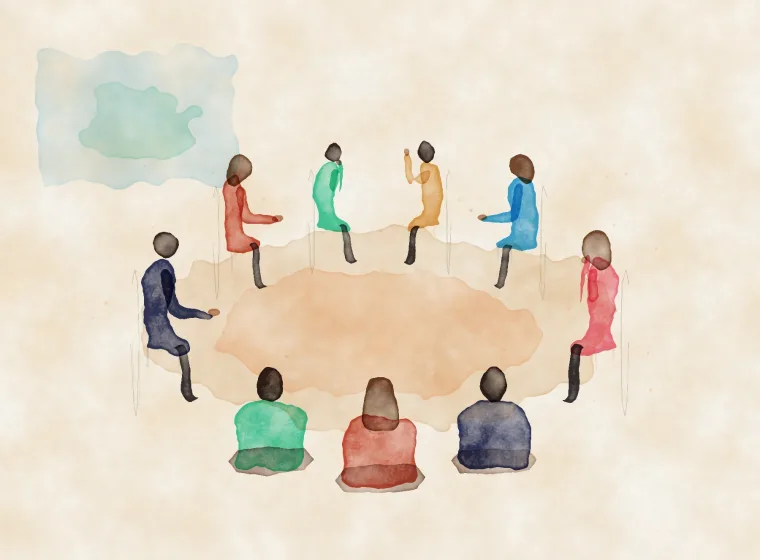
- Name what’s at stakeWe agree the purpose and the ground rules. They protect challenge, not comfort.
- NoticePeople learn to spot their own threat reactions in real time, and to name them without being ruled by them.
- RehearseRealistic scenarios drawn from their own work. Run, paused, discussed and run again, differently.
- Take it backEveryone leaves with one conversation they intend to have, and a plan for how to open it.
Clear boundaries
What this is, and what it isn’t.
It is
- Skills practice, built around situations your people actually face
- Rigorous, research-informed and designed for adults with real responsibilities
- Tailored to your setting, your pressures and your level of risk
- Confidential, with nothing shared beyond the room without agreement
It isn’t
- Mediation. We don’t rule on who’s right or broker settlements
- Therapy. The focus is skill and practice, not personal history
- A script for winning arguments
- A position on contested issues. We don’t tell people what to think
Questions
What people
ask before
they book.
Do you take sides on contested issues?
No. We work with people who hold strong and opposing views, and the aim is never to move anyone toward a position. It’s to help them examine positions, including their own, more honestly.
What if people aren’t ready to speak openly in front of colleagues?
That’s common, and we plan for it. Nobody is asked to disclose personal views or experiences. We begin with realistic scenarios rather than people’s own disputes, agree ground rules before anything difficult is discussed, and build trust before raising the stakes. People choose how far to engage, and many find they’re ready to say more as the session goes on.
Is what’s said in the room kept confidential?
[Placeholder] Yes. Every engagement is treated in confidence, and nothing said in the room is shared beyond it without agreement.
Do you work online?
[Placeholder] Answer to be confirmed: whether sessions run online, in person or both.
How do you know it worked?
[Placeholder] Answer to be confirmed: how progress is agreed and measured with each client.
How is it priced?
[Placeholder] Answer to be confirmed: how engagements are scoped and priced.
Next step
See where your
team stands.
Find out how your team handles disagreement, and what to try first.